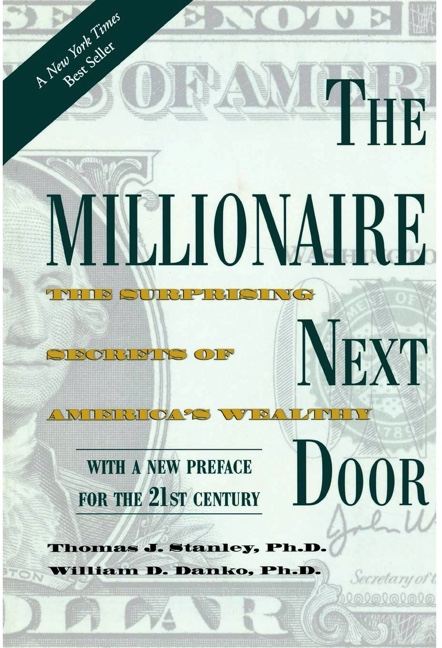
A groundbreaking study that demolishes myths about wealth and reveals the actual spending and planning habits of America’s millionaires. Essential reading for anyone serious about building wealth.
Many of the ideas in this book pair well with modern behavioral finance concepts discussed in The Psychology of Money Book Review, especially around long-term decision-making, patience, and avoiding status-driven financial mistakes.
Book Overview & First Impressions
I first read The Millionaire Next Door by Thomas Stanley and William Danko before starting law school in 1997, and it blew me away. The book demolishes the myths about who the wealthy really are in America, and more importantly, shares their spending and planning habits so we could learn from them. It’s my first choice whenever anyone asks for a personal finance book recommendation.
The spending stats are dated, and Stanley wrote a follow-up book in 2011 Stop Acting Rich: And Start Living Like a Real Millionaire that provided some updates. However, the points come across loud and clear and are based on research about millionaires and surveys of them.
Key Insights & Research Foundation
It presents formulas like how to determine if you’re on track to becoming wealthy and how much home you can afford.
The Wealth Equation
One of the book’s most practical contributions is a simple formula to assess your wealth-building progress:
Expected Net Worth Formula Your expected net worth = (Age × Pre-tax Annual Income) / 10
Prodigious Accumulator of Wealth (PAW): Net worth is 2× or more the expected amount
Under Accumulator of Wealth (UAW): Net worth is half or less the expected amount
This idea of measuring progress instead of chasing lifestyle upgrades connects closely with the framework discussed in Book Review: The Algebra of Wealth by Professor Galloway, which emphasizes asymmetry, time, and disciplined behavior over flashy wins.
Real Millionaire Spending Data
The book shares data on what the average millionaire spent on things like cars, watches, wine, meals, and haircuts. This data reveals a striking pattern: most millionaires are remarkably frugal, prioritizing wealth accumulation over status symbols.
Key Finding: The majority of millionaires drive modest vehicles, live in middle-class neighborhoods, and spend considerably less than their means would allow. They understand that every dollar spent on consumption is a dollar that can’t compound and grow.
The Seven Traits of Wealthy Americans
The Millionaire Next Door highlighted seven traits shared by wealthy Americans. These characteristics form the foundation of sustainable wealth building:
Living well below their means. Wealthy individuals consistently spend less than they earn, prioritizing saving and investing over consumption. This discipline creates the capital necessary for investment and wealth accumulation.
They allocate their time, energy, and money efficiently, in ways conducive to building wealth. Millionaires focus their resources on wealth-building activities rather than status symbols. They invest time in financial planning, researching investments, and developing income-producing skills.
They believe that financial independence is more important than displaying high social status. True wealth is measured by financial freedom, not by outward appearances or luxury possessions. They prioritize security and autonomy over impressing others.
Their parents did not provide economic outpatient care. Most millionaires didn’t rely on family wealth and built their fortunes through their own efforts and discipline. They learned self-reliance and financial responsibility early in life.
Their adult children are economically self-sufficient. Wealthy parents raise financially independent children, teaching them the value of self-reliance and financial responsibility. They avoid creating dependency through excessive financial support.
They are proficient in targeting marketing opportunities. Successful millionaires identify and capitalize on business and investment opportunities that others overlook. They develop expertise in recognizing undervalued assets and emerging markets.
They chose the right occupation. Many millionaires selected careers with high income potential and opportunities for business ownership or investment. They often own businesses or work in professional services where income potential scales with effort and expertise.
Others have shared these insights, but never this clearly and well-organized. This is the original, and I strongly encourage you to check it out if you haven’t already.
What Millionaires Actually Spend On
It shares data on what the average millionaire spent on things like cars, watches, wine, meals, and haircuts.
Spending Reality Check:Most millionaires spend far less on luxury items than you’d expect. They view purchases through the lens of opportunity cost—every dollar spent on a luxury item is a dollar that can’t be invested and compounded over time.
Common Spending Patterns
The research reveals that wealthy Americans:
Buy used or moderately-priced vehicles rather than luxury cars
Spend conservatively on clothing and accessories
Live in neighborhoods below what they could afford
Budget carefully even with substantial wealth
View frugality as a virtue, not a sacrifice
Frequently Asked Questions
Is The Millionaire Next Door still relevant today?
Absolutely. While some spending statistics are dated, the core principles about wealth-building behaviors remain timeless. The 2011 follow-up “Stop Acting Rich” provides updated data, but the fundamental insights about frugality, efficient resource allocation, and prioritizing financial independence over status remain as relevant as ever in 2025.
What’s the main difference between millionaires and high-income earners?
The book reveals that many millionaires don’t have extraordinarily high incomes. The key difference is their behavior: they live well below their means, invest consistently, and avoid lifestyle inflation. Meanwhile, many high-income earners spend everything they make on status symbols and never build real wealth. It’s not what you earn, it’s what you keep and invest.
Can you become a millionaire without a high-paying career?
Yes. The book shows that many millionaires work in ordinary occupations like teaching, engineering, or small business ownership. The key is consistent saving, smart investing, and living below your means over a long period. It’s about behavior and discipline, not just income level. Time and compound interest are powerful wealth-building tools available to everyone.
What’s the “wealth formula” mentioned in the book?
The book provides a formula to determine if you’re on track: Your expected net worth = (Age × Pre-tax Annual Income) / 10. If your actual net worth is twice this amount, you’re a “prodigious accumulator of wealth” (PAW). If it’s half or less, you’re an “under accumulator of wealth” (UAW). This formula helps you benchmark your progress against typical wealth builders.
Should I read “Stop Acting Rich” or “The Millionaire Next Door” first?
Start with “The Millionaire Next Door” as it provides the foundational research and insights. “Stop Acting Rich” (2011) builds on these concepts with updated data and focuses more specifically on consumption patterns and the psychology of status-seeking spending. Both are valuable, but The Millionaire Next Door is the essential starting point for understanding wealth-building principles.
What’s the most surprising finding from the book?
Perhaps most surprising is that the majority of millionaires don’t live in expensive neighborhoods, drive luxury cars, or wear designer clothes. They’re often your neighbors living modest lifestyles while accumulating significant wealth through disciplined saving and investing—hence the title “The Millionaire Next Door.” The wealthy often look quite ordinary from the outside.
How does “economic outpatient care” hurt wealth building?
The book reveals that adult children who receive substantial financial support from parents (economic outpatient care) tend to accumulate less wealth than those who don’t. This support creates dependency, reduces motivation to save, and often leads to lifestyle inflation. Self-made millionaires typically didn’t receive this support and learned financial discipline through necessity.
What occupations are most common among millionaires?
The book found that business owners, particularly those in unglamorous industries, make up a large percentage of millionaires. Professionals like doctors, lawyers, accountants, and engineers are also well-represented, but not always as wealthy as you’d expect due to higher spending. The common thread is choosing occupations with entrepreneurial opportunities or significant income potential combined with disciplined saving habits.