
In Your Money This Week, Andrew and I covered a lot of ground, including a stronger-than-expected economy, a rough stretch for the biggest AI names, inflation that won’t cool, housing market predictions, and the official kickoff of our book club.
The economy picked up steam. GDP grew at a 3.4% annualized rate in the third quarter, ahead of expectations. Consumers kept spending, and business investment surged, led by the computer equipment behind the AI build-out. Inflation is still an issue. PCE, the Fed’s preferred measure, came in at 3.6%, well above the Fed’s target.
Is the AI trade cracking? Four of the biggest AI spenders (Meta, Microsoft, Alphabet and Amazon) reported earnings over the past two weeks, and investors didn’t like much of what they saw. Several are now well off their highs, and the Nasdaq has fallen 8.5% since early October. Meanwhile, small caps and the equal-weight S&P 500 have pulled back ahead of the S&P 500 for the year. Andrew walks through what happened in each report and why Microsoft was the exception. I take on a question I hear constantly: is AI a bubble? We start with what a bubble actually is, then explain why we’ve been urging diversification for months, and how the market sell-off should paradoxically reassure those worried about a bubble.
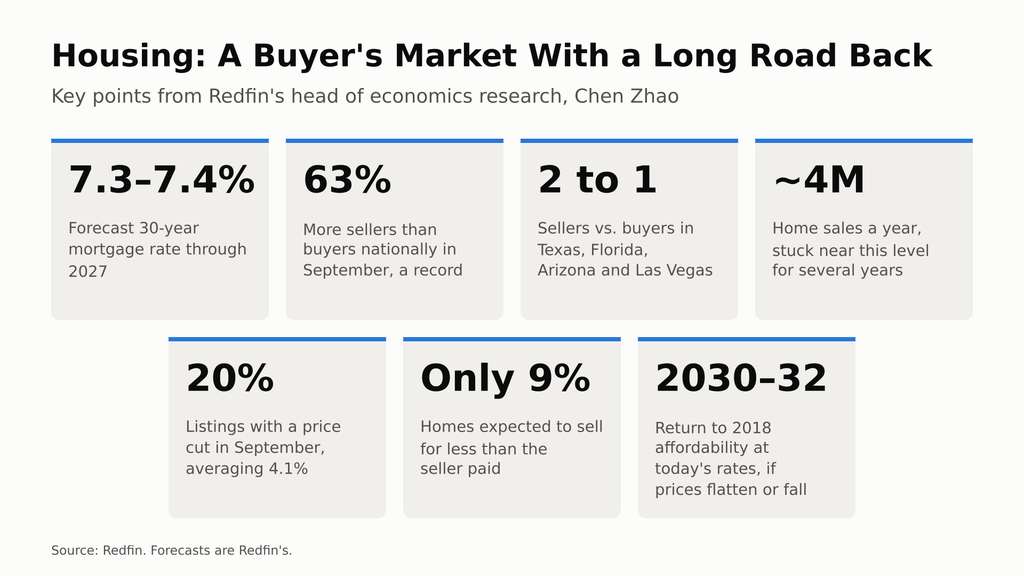
Housing’s long road back. Building on last week’s discussion, we share insights from Redfin economist Chen Zhao. Sellers now outnumber buyers by a record margin, and price cuts are near record levels. The picture looks very different depending on where you live. The forecast for mortgage rates over the next year isn’t encouraging, and getting back to “normal” affordability could take years.
Our first book club pick. We formally kick off our book club with The Everywhere Millionaire: Who Is Really Rich in America and How They Got There. It’s built on an unprecedented set of tax data, and it upends a lot of assumptions about who the wealthy are. Hint: it’s less tech founders and more the owners of the businesses you drive past every day. We also get into how they built their wealth, where entrepreneurs come from, and why family fortunes rarely last. Check out my book review here.
Next month, we will be discussing Money to Burn: The Unvarnished Truth About Leon Black, Apollo, and the Rise of a New Wall Street.
We wrap up referencing four articles you should check out.
- Value Breakout Shows Benefits of Diversification by Professor Jeremy Siegel echoes that the market is becoming less of a one-way AI trade: doubts about the durability of AI spending have pushed money toward value stocks and bonds, while the 10-year Treasury yield slipping below 5% has helped rate-sensitive areas of the market. Owning only the recent AI winners creates more concentrated risk than it may appear, and diversification across value and bonds can provide a counterweight if AI capital spending or expected returns disappoint.
- What a Democratic Congress Would Mean for Wall Street by Barron’s explains that the midterms could change the balance of power in Washington and increase scrutiny of areas such as banking, healthcare, crypto, AI, energy, and housing, but major legislative changes would still be difficult under divided government and a presidential veto. The broader market impact may therefore come more from policy uncertainty, regulation, and fiscal fights than from sweeping new laws, with AI data centers and federal deficits remaining important issues for investors.
- Anthropic’s Massive Revenue Surge Comes With Ballooning Computing Bill by Bloomberg looks at Anthropic and finds that its revenue is growing at an extraordinary pace, reaching $16.3 billion in the first half of 2026, but that growth is being matched by enormous computing costs and hundreds of billions of dollars of future infrastructure commitments. The key question for investors is whether sales can continue expanding fast enough to cover those costs, especially with intense competition, heavy customer concentration, and circular relationships in which major cloud providers are simultaneously investors, suppliers, and customers. Anthropic therefore represents both the scale of the AI opportunity and the financial risk of a business model that still requires massive spending to sustain growth.
- Making your wealth last longer in retirement by Vanguard says that retirees can improve their financial flexibility by paying down high-interest debt, coordinating withdrawals across taxable, tax-deferred, and Roth accounts, and considering Roth conversions during lower-income years. Spending can also be adjusted modestly when markets are weak or strong to help preserve the portfolio and reduce the risk of larger cuts later. Estate planning remains part of retirement planning as well, including powers of attorney, beneficiary designations, and proper account titling.
We get into all of this in this week’s video, now available at YouTube, Spotify, Apple, and wherever you get your podcasts.