
In Your Money This Week, the Fed raised interest rates for the first time since 2023, and there’s a question whether it was the right move.
Fed Rate Hike
The Fed is in a tough spot. Inflation has been running above its 2% target for five years, but a rate hike can’t stop the Iran war which is a large culprit in today’s sticky inflation. But it could slow down the economy since rate hikes tend to come in bunches. much of the recent increase has been driven by higher oil prices because of the Iran war.
At the same time, it’s hard to argue that the economy needs lower rates. If you believe the data, it’s growing, the labor market is at full employment, and corporate earnings are great.
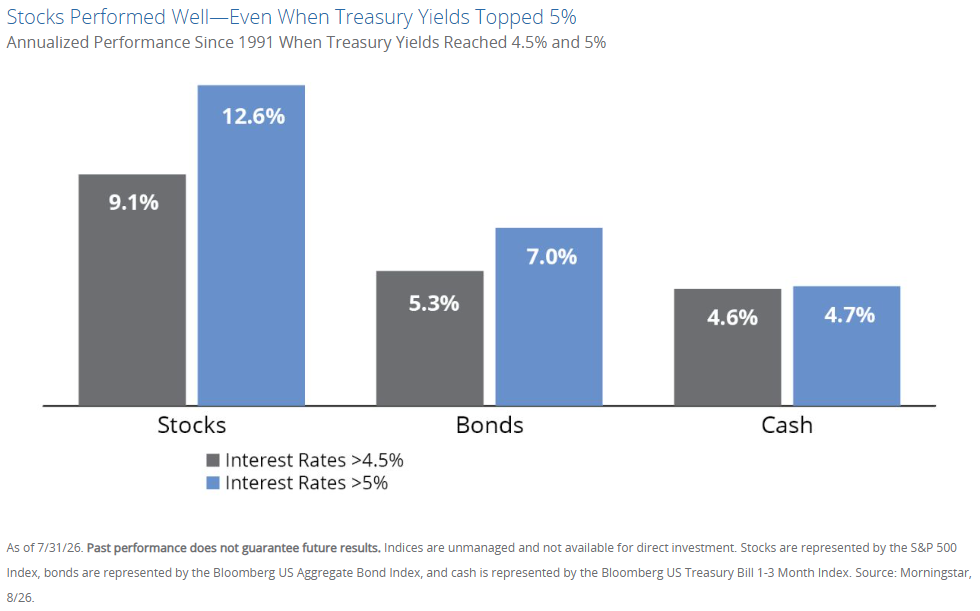
We’ll see what transpires. In the meantime, investors shouldn’t automatically assume higher rates means trouble for stocks.
There’s an interesting paradox with interest rates and the stock market. The Fed generally raises rates when the economy is doing well and cuts them when the economy needs help. Stocks historically tend to be positive six to twelve months later. One recent exception was 2022, but then the Fed was hiking rates to deal with 9% inflation.
Rate-cutting cycles when the economy is struggling are typically accompanied by stock market losses. We’ll see if that pattern holds.
Higher Yields
We’re also seeing the 10-Year Treasury at or near 5% yields. Higher yields can hurt stocks because they increase borrowing costs and create more competition for stocks. But it isn’t as simple as high yields equal stock prices decline as you can see from this chart.
AI
Then there’s AI.
Some who are building the technology are warning that increasingly powerful AI could have catastrophic consequences.
Two posts in particular received much attention. The first was one on X I found particularly vague, useless, and confusing. The second was the letter from Anthropic’s CEO.
His main points: The AI tools are getting better at what they call recursive self-improvement, basically AI’s ability to build AI, which could lead to losing control of AI systems that go rogue and cause damage. The race to finish first is damaging and we need to slow AI’s improvement.
I’m skeptical.
Besides the marketing glitz from telling us how powerful their tools are, AI CEOs might be:
- Motivated to slow the AI arms race down to reduce the enormous amounts these companies are spending.
- Dealing with the reality that their revenue and profitability aren’t matching expectations as they prepare to go public
- Trying to shut the door behind emerging competitors
Listener Question
A listener asked what financial advisors and their custodians are doing to prevent AI from hacking investment accounts and stealing the money. To submit a listener question, email me at sammy@thebostonadvisor.com.
Andrew and I get into this and more in this week’s video followed by weekly reads.
Weekly Reads
WHAT THE FED’S HIKE MEANS FOR THE NEXT 6 MONTHS OF REAL ESTATE by The CRE Report
The Fed’s rate hike adds pressure to commercial real estate because borrowing costs are now close to—or in some sectors above—property yields, reducing the benefit of leverage and making new deals harder to justify. The bigger challenge will come as loans mature: refinancing at higher rates can sharply increase interest expense and lenders may require more equity, potentially forcing some owners—particularly in office—to sell, restructure debt, or bring in additional capital. Higher financing costs could also push cap rates higher and property values lower, creating potential opportunities in 2027 for investors with capital to fill refinancing gaps or acquire properties from owners who cannot refinance on acceptable terms.
Ed Slott: Don’t Waste Your Low-Tax Years in Retirement by Morningstar
Early retirement can create a valuable low-tax window before required minimum distributions begin, making it an opportune time for Roth conversions, traditional IRA withdrawals and potentially realizing capital gains while tax rates are lower. Retirees should generally preserve Roth assets for later and consider deliberately reducing large tax-deferred balances now, even if that means paying some taxes earlier, to reduce future RMDs and potentially recurring Medicare IRMAA surcharges. Withholding taxes directly from retirement distributions can also simplify tax payments and help avoid estimated-tax penalties.
The Simple Request That Could Lower Your Mortgage Rate by The Wall Street Journal
Homebuyers should ask their mortgage lender to check both their classic FICO score and VantageScore 4.0, because lenders can now use whichever produces better mortgage pricing. The models evaluate credit differently, and roughly one in four buyers may move into a higher credit-score range when both are considered, potentially qualifying for lower fees and interest rates. The benefit varies by borrower, but those with a history of maintaining low balances and paying bills on time may particularly benefit from having VantageScore 4.0 considered.
‘Big Short’ investor Steve Eisman on AI: The companies are trying to manufacture a crisis by CNBC
The clip contained in this article is worth watching as Eisman takes the other side of the AI fears and calls out the companies for creating them.
How to Plan for Healthcare Costs in Retirement by Savant Wealth
Healthcare should be explicitly included in retirement planning, with the average 65-year-old retiree estimated to face $172,500 in lifetime healthcare costs that could otherwise consume money intended for other goals. Retirees should understand what Medicare does and does not cover, evaluate supplemental insurance such as Medigap during its six-month enrollment window, and manage income with Medicare Part B and D premiums in mind because they are tied to modified adjusted gross income. Building healthcare costs into retirement spending projections and using tools such as HSAs can help fund routine expenses, while potential nursing-home costs and the need for long-term care insurance should also be considered.
1873: The Rothschilds, the First Great Depression, and the Making of the Modern World by Liaquat Ahamed
The railroad boom in the 1800’s has parallels to today’s AI build-out and the 1873 crash set the state globally politically and economically for the following decades and still reverberates today.
From the author of the Pulitzer Prize–winning Lords of Finance, a magnificent and timely reckoning with the first truly global financial calamity and the famous banking family at the center of the whirlwind.