
Retirement planning for business owners is different than it is for employees. An investment portfolio funds most people’s retirements, and for a business owner, the capital to build that portfolio will likely come from your largest asset – your business. For retirement success, you need to tax-efficiently pull cash from your business and have a thoughtful exit strategy to cash out on your own terms. This can be done through smart retirement plan design, consistent savings targets, and a good business succession plan.
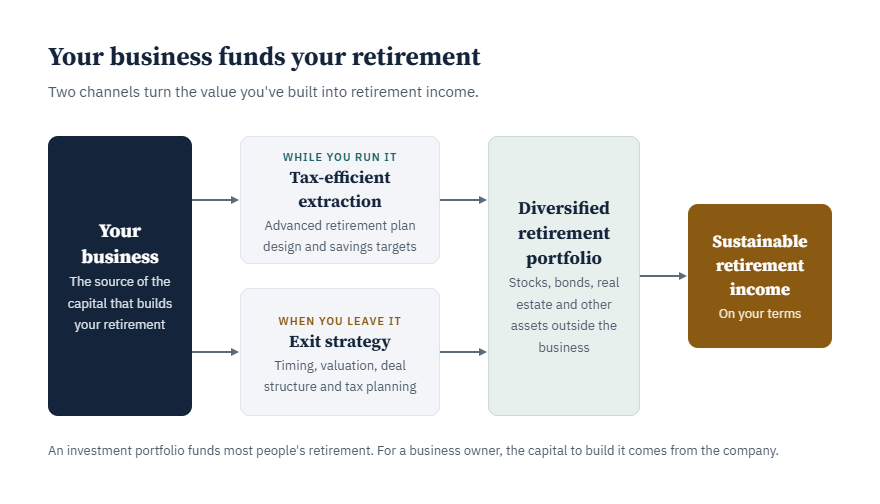
Pull Cash Out Through Advanced Retirement Plan Design
Business owners play a dual role. Unlike employees, you are both the plan sponsor and a participant. You have significant control over the type of plan, its contribution structure, and the investment options offered, subject to plan rules and employee requirements. This gives you the opportunity to design a plan that can save on taxes and build large retirement account balances.
You should be thinking beyond SEP IRAs, SIMPLE IRAs, and SIMPLE 401(k)s. Yes, they are easy to set up and cheap to administer, but the SIMPLEs have much lower contribution limits than a 401(k), and SEP IRAs generally require you to contribute the same percentage of pay for eligible employees as you do for yourself.
Some stronger options:
- Solo 401(k): If you have no eligible employees other than a spouse, this plan lets you contribute as both employer and employee, maximizing annual savings and allowing catch-up contributions for those 50 and older.
- Cross-tested profit sharing: This can enable higher contributions for owners and key employees relative to staff, subject to nondiscrimination and other compliance testing. It can be a strong option for highly compensated owners.
- Defined benefit and cash balance plans: If your business’s cash flow is steady and strong, these can allow very large, sometimes six-figure, tax-deductible contributions. Contribution levels depend on factors including age, compensation, and plan design, and the business takes on greater funding obligations.
The right plan depends not just on how much you want to save, but on your workforce and the consistency of your business’s cash flow. Employee count, ages, compensation levels, and profitability can materially affect which plan design makes the most sense.
Set Savings Targets and Diversify
While the business is often a significant asset, retirement planning for business owners should also focus on diversification. Create auto-saving targets, regularly moving cash from the business into investments that fund your retirement, to turn your business success into liquid financial success. Allocate windfalls to savings or strategic investments before they’re spent. Diversifying into other assets such as stocks, bonds, real estate, or alternative investments can provide additional security and stability.
Treat Your Exit Strategy as Part of Your Retirement Plan
You will exit your business at some point. Do you want to do it on your own terms and in the most financially advantageous way possible as a reward for your years of entrepreneurship and sacrifice?
Determining the value of your business and planning for its eventual sale or transfer is critical to your retirement planning. Decide whether to keep the business in the family, transfer it to employees, merge, or seek an external sale. A sale is often the largest and most complex transaction of your life, and early preparation is essential. Ideally, begin preparing three to five years before your targeted liquidity event:
- Know what it’s worth: Routinely commission professional business valuations so you can negotiate a good price.
- Polish financials and operations: Address any financial inconsistencies, clean up documentation, streamline operations, and shore up contracts that impact valuation.
- Maximize value: Enhance profitability, diversify your customer base, secure long-term contracts, and build a strong, independent management team.
- Open up the process: If one buyer is interested, it’s likely more would be. You may benefit from a competitive sales process.
- Plan for taxes: Deal structure impacts the taxes you pay. Asset sales, stock sales, and mergers can have materially different tax consequences. Explore installment sales, charitable trusts, and other vehicles to minimize or spread the tax on your proceeds. Hire a good tax person with deal experience, and don’t assume your current CPA is the right fit.
Most importantly, understand what the numbers mean for you. Will you get enough after-tax liquidity to retire, or at least cut back after the deal? What do you need in a deal to make it work for you financially? Hire an advisor to build a financial plan that models what you can afford to spend after your business sale.
When you sell matters too. I wrote about this recently in When to Sell Your Business: Economic Timing Matters, but the main point is:
There are many considerations that go into deciding when to sell your business. If selling within the next few years is already part of your plan, consider whether today represents a sufficiently attractive exit window rather than risk being forced to wait through a downturn to get back to where you are now.
Plan for Healthcare Costs
Healthcare expenses are a growing concern for business owners planning for the long run and one of retirement’s most unpredictable expenses. If you have a high-deductible health plan, you can open and fund a Health Savings Account. It’s a powerful, triple-tax-advantaged account: contributions are pre-tax, growth is tax-free, and withdrawals for eligible medical expenses are tax-free.
HSA funds can be invested, and you keep the account after you retire. Contribute the maximum each year and invest the balance, and the HSA can become a “hidden IRA” for health costs in your 60s and beyond.
Keep Your Plan Current
A plan is only as strong as its last update. Review your retirement plan design and contribution rates annually, and immediately revisit your plan after any business transition, change in tax law, major family event, or significant market movement.
When business owners aren’t working with an advisor, these are the things that don’t get enough attention. Your advisor conversations should cover whether your retirement plan design is still the right fit for your income and staff, whether your savings targets are keeping pace with what the business earns, what your business is worth today, and whether your exit timeline is realistic. Choosing the right advisors is important. Seek professionals with extensive experience working with businesses similar to yours in stage, size, and complexity. With a proactive, integrated plan, you can turn the business you’ve built into the retirement you’ve earned, on your own terms.