
Jesse Livermore, aka the Boy Plunger, had an unparalleled trading career in the early 1900s that was fictionalized as Larry Livingston’s in Reminiscences of a Stock Operator, an investing classic.
Livermore speculated his way to multiple fortunes and crashes. Extracting prudent investment lessons from a chaotic trading career is challenging, but their are investing lessons we can take from Jesse Livermore. Alan Greenspan considered Reminiscences “a font of investing wisdom.” Fortune named it one the “The Smartest Books We Know” about business. His successes, failures, and market observations offer valuable lessons for investors about patience, judgment, risk, and protecting capital.
Livermore started trading as a teen in bucket shops, which were essentially horse-racing betting parlors for amateur investors. Customers bet on whether a stock would rise or fall on thin margin that could be wiped out if the price moved against them. He won so often that he was banned from bucket shops in Boston, St. Louis, and New Jersey with a failed stint at legitimate trading in New York City along the way.
First Fortune and Wipeout
Livermore shorted Union Pacific before the 1906 San Francisco earthquake, then increased the bet when he concluded the earthquake’s economic damage would be worse than market expectations.
He was still bearish still 1907 and made $1 million in a day during the credit crisis JP Morgan ended by bailing out Wall Street. Morgan’s people even asked Livermore to stop shorting the market so it could recover.
The final step in building his few million-dollar 1908 fortune was some lucky cotton trades.
He lost it all soon thereafter trading commodities and stocks.
World War I Era Rebuild and His 1929 Peak
Livermore was sidelined for a few years as he rebuilt his cash pile. He made some money during the 1915-1916 World War I bull market, and then correctly called the market reversal after the war. By 1923, his money management operation employed sixty people, and The New York Times reported his market calls.
The Boy Plunger made $100 million shorting the stock market in 1929—about $2 billion today. Anticipating that the Roaring 20s would end badly, he used probing trades to build his capital, then leveraged it to short $450 million in stocks. Black Tuesday alone reportedly netted him $100 million.
Losing It All, Including His Life
Sadly, for Livermore it wasn’t enough. He chased more money and wins, but got wiped out instead. By 1934, he was broke and bankrupt. He killed himself in 1940.
Investment Lessons
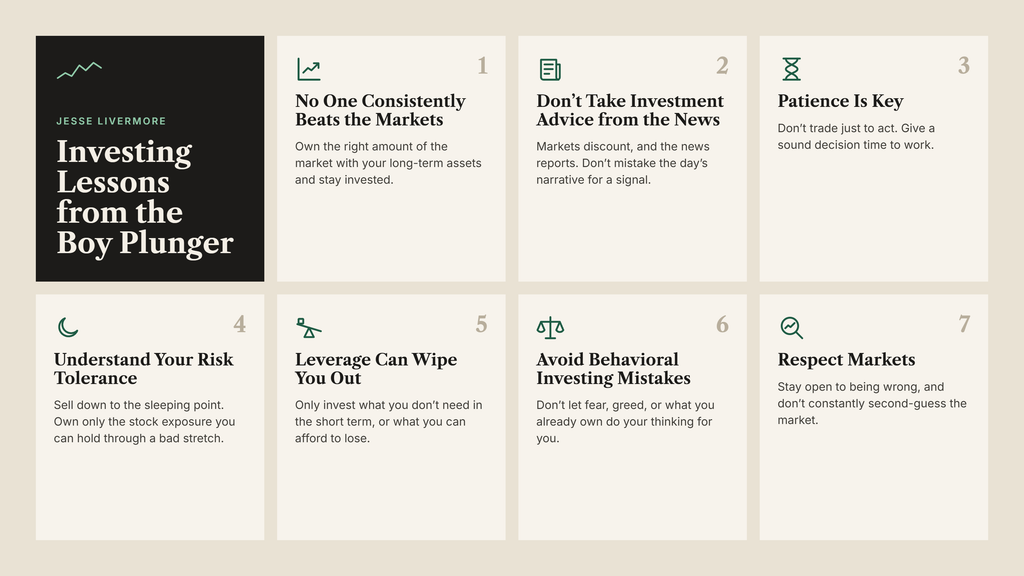
Own the Market Instead of Trying to Beat It
Don’t expect to consistently beat the market. As told in Reminiscences: “The conclusion that I have reached after nearly thirty years of constant trading, both on a shoestring and with millions of dollars back of me, is this: A man may beat a stock or a group at a certain time, but no man living can beat the stock market!”
What Livermore eventually learned was that “the big money was not in the individual fluctuations but in the main movements.” For long-term investors, the lesson isn’t to try to predict those movements. The market’s general direction matters far more than picking the right stock or timing every turn, and over long periods that direction has historically been up. For your long-term assets, the goal is to have the right amount invested in the market and stay invested.
Don’t Take Investment Advice from the News
Too many investors take their cues from the financial news media, but the news mostly explains what has already happened. Reporters aren’t investment analysts, and current events alone aren’t a reliable guide to future returns.
In Reminiscences, Livingston argued that stock prices move “six to nine months ahead of actual conditions” because investors are making decisions today about what they expect to happen next. Markets discount, and the news reports. Getting that backwards can crush your portfolio.
There is still value in staying informed. Knowing what the market expects helps explain price moves, because surprises often matter more than the news itself.
But take what you hear with a grain of salt. Financial news has to explain why markets move every day, even when the real answer isn’t clear. Livermore saw the same thing a century ago in what he called “the public’s insatiable demand for reasons for each and every price movement.”
When you hear the market fell because of something that happened somewhere, the more honest version is often: The market is down and we had to tell you why, so this was what we came up with today. Commentators also have their own incentives, positions, or agendas.
Patience is Key
Being active doesn’t make you a better investor. Early in his career, Livermore lost money by trading when he had no real reason to. As Livingston put it in Reminiscences, “There is the Wall Street fool, who thinks he must trade all the time.” The same mistake applies to investors today: make portfolio changes for rational investment reasons, not in reaction to today’s events.
Patience also means giving a sound investment decision time to work. Livingston said, “It never was my thinking that made the big money for me. It was always my sitting,” adding that “men who can both be right and sit tight are uncommon.” If your investment case remains intact, don’t let impatience turn a sound decision into a bad one.
Understand Your Risk Tolerance
You need a portfolio you can live with. Livermore liked an old story from Dickson G. Watts about a man carrying so much cotton that he couldn’t sleep.
“What can I do?” the man asked.
“Sell down to the sleeping point,” his friend answered.
For investors, that means owning the right amount of stocks for your plan and your ability to tolerate market declines. More stocks may produce higher long-term returns, but not if too much risk causes you to sell during a downturn. The right allocation is one you can stick with when markets get difficult.
Leverage Can Wipe You Out
Livermore’s biggest bets were made with borrowed money. In the run-up to the 1929 crash, he used $7 million of his own money to bet against $150 million of stock. That trade worked, but leverage meant a modest move against him could destroy a fortune, and he went broke more than once. The lesson for investors goes beyond borrowing: Only invest what you don’t need in the short term if it’s a diversified portfolio that could fluctuate in value, or what you can lose if it’s a speculative investment.
Avoiding Behavioral Investing Mistakes
Avoiding mistakes is a huge part of investing, and that Jesse Livermore investing lesson was learned the hard way. “There is nothing like losing all you have in the world for teaching you what not to do. And when you know what not to do in order not to lose money, you begin to learn what to do in order to win.” Many of the costliest mistakes aren’t analytical. They’re behavioral.
Don’t become emotionally attached to an investment simply because you own it. In Reminiscences, Livingston describes the problem this way: “You find many people, reputed to be intelligent, who are bullish because they have stocks. I do not allow my possessions or my prepossessions either to do any thinking for me.”
Fear and greed are among investing’s biggest behavioral challenges. Livermore often focused on hope and fear. After 1929, he could have retired as one of the world’s richest people, but his desire for another enormous win helped cost him his fortune.
Self-awareness matters too. Know your limitations, strengths, weaknesses, and areas of expertise. Livermore kept a book recording his hits and misses, and Livingston says in Reminiscences, “I have always found it profitable to study my mistakes.”
Respect Markets
Respect what markets are telling you. We’re not speculating in stocks like Livermore, but there is still something to learn from his experience. He regretted fighting the market when the evidence moved against him, including adding to losing positions: “Of all speculative blunders there are few greater than trying to average a losing game.” He also regretted selling winners simply to lock in a gain: “They say you never grow poor taking profits. No, you don’t. But neither do you grow rich taking a four-point profit in a bull market.”
Markets process enormous amounts of information and reflect the collective judgment of trillions of dollars of investor capital. They can overreact in the short term, but when the market moves against one of your decisions, be cautious about assuming you know better. Respect the evidence, stay open to being wrong, and don’t constantly second-guess the market.