
Minimizing your taxable portfolio’s capital gains is an important part of portfolio management and retirement planning.
Short-term gains (positions held for one year or less) are taxed federally at your ordinary income tax rate. Long-term gains (positions held for more than one year) are taxed at 0%, 15%, or 20%. Higher-income taxpayers may also owe 3.8% Net Investment Income Tax (NIIT). Any applicable state income taxes are additional.
The 0% rate applies only to the portion of long-term capital gains that falls below certain taxable-income thresholds (2026: $49,450 for single filers and $98,900 for married filing jointly).
Tax-Loss Selling Approaches
Minimizing those taxes leaves you with more capital for future growth. One common way is through tax-loss selling.
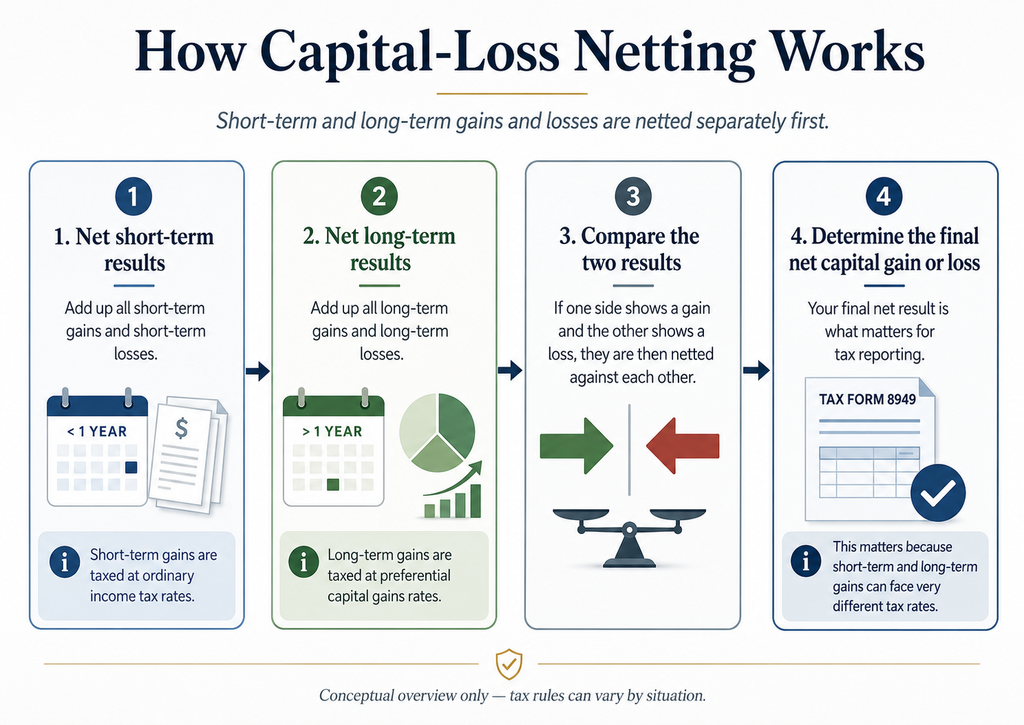
If your losses exceed your gains for the year, you can use up to $3,000 to reduce ordinary income and carry remaining losses to future years.
There are various ways to approach tax-loss selling.
At its most basic, you sell a position at a loss and in a way that avoids the wash sale rules.
You can also do this more opportunistically during market selloffs, or more programmatically, using strategies designed to create more tax-loss harvesting opportunities than a traditional portfolio.
Portfolio Examples
Single ETF Portfolio
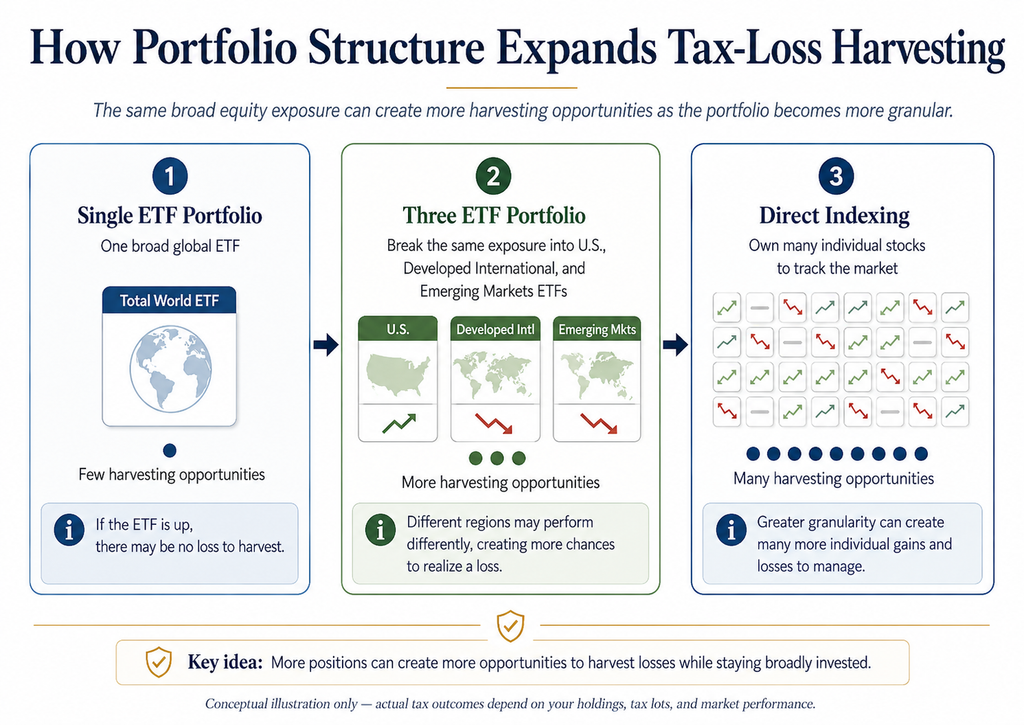
To understand the more complicated approaches, I’ll start with a single ETF portfolio – Vanguard’s Total World Stock ETF. It holds over 10,000 stocks and covers the global stock market, meaning the U.S., Developed International, and Emerging Markets.
If you owned it, and it was down 10% (or one lot was) you could tax-loss harvest it. But that’s where your tax-loss harvesting opportunities end. It’s one position and all your lots are up, there are no losses in the portfolio to harvest.
Three ETF Portfolio
That’s the case even though U.S. stocks could be up since you bought the ETF, but emerging markets stocks are down, and if you had broken up that portfolio into three ETFs –U.S., Developed International, and Emerging Markets, you could sell the emerging markets one and book that loss.
Direct Indexing
You can take this a level deeper: instead of owning three ETFs, you could own many of the individual stocks they hold, dramatically increasing your opportunities to tax-loss harvest.
That is now possible through Direct Indexing strategies, where money managers purchase hundreds or thousands of stocks for you in a separately managed account to track an index.
Let’s say we’re tracking the S&P 500. It’s usually up, but in any given year there are many stocks not performing well. Direct Indexing allows you to harvest losses in those positions, while remaining fully invested and generally tracking the index’s performance (there is some tracking error).
Long/Short Direct-Indexing
One limitation with Direct Indexing is that the portfolio will eventually have diminished opportunities to harvest losses absent adding new cash.
Long-short tax-loss harvesting strategies address this issue by using leverage to add both long and short positions, creating more opportunities to harvest losses. In a 130/30 strategy, a $1,000,000 portfolio has $1.3 million of long exposure and $300,000 of short exposure, for net market exposure of 100%.
Selling short means borrowing and selling stock, then profiting if you can buy it back later at a lower price.
These long/short extensions create more opportunities to tax-loss harvest and reduce the direct-indexing ossification we discussed above.
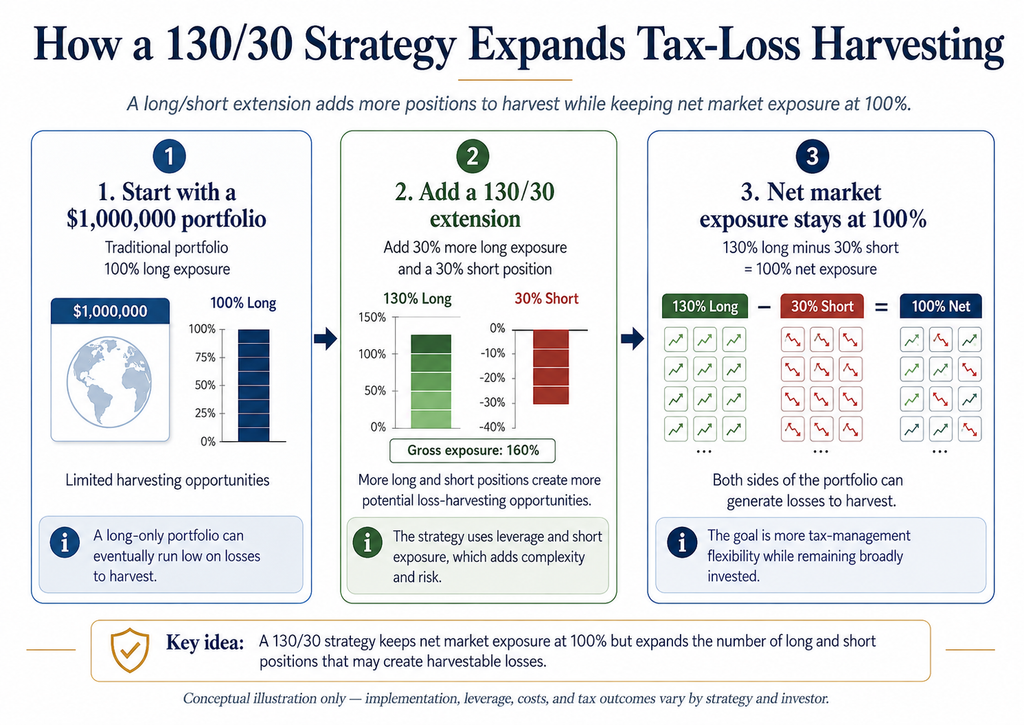
The strategies are more complicated, and there are downsides to the long-short extensions to navigate before pursuing. Here’s a good educational piece.
Broader Use Cases
These strategies can help offset the capital-gain portion of business and real estate sales, after accounting for depreciation recapture and other amounts taxed differently.
They’re best started with cash versus an existing stock or ETF portfolio. You can use them prior to a transaction to build up losses for when you have a large liquidity event. You could use them in the year of your transaction with your proceeds to harvest losses to offset your deal gains. And if your transaction involves multiple payments, you could have multiple years of loss harvesting available to you.
Conclusion
Tax minimization is an important part of portfolio management and building wealth. Tax-loss selling can be as simple as harvesting a loss in a traditional portfolio or as sophisticated as direct indexing and long/short strategies. The more advanced approaches create more opportunities, but they also add complexity, costs, and risks that need to be weighed against the potential tax benefits.