
In Your Money This Week, I’m digging into a listener question that came out of last week’s episode: Is the economy really strong, or are we looking at the wrong data—or not being skeptical enough about it—while a strong stock market distracts us from trouble ahead?
There are really three questions: What does the data say? Can we trust it? And what, if anything, should investors do about it?
Looking at the numbers, it’s hard to support either extreme. The economy isn’t obviously booming, but there also isn’t much evidence that it’s secretly in recession. The data supports a resilient economy that is growing slowly despite some headwinds, with pressure on households and narrower growth than we’d want.
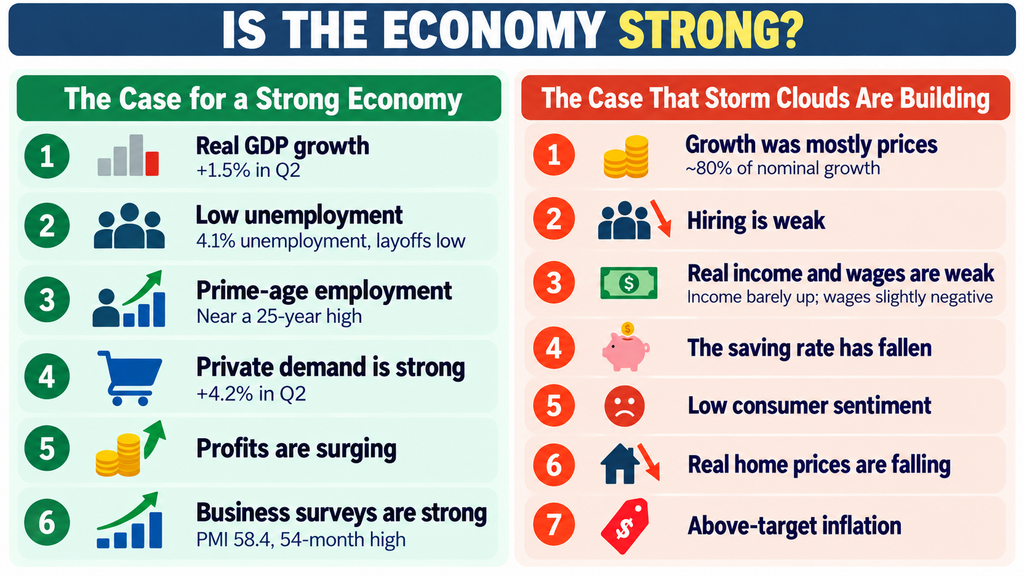
The case for strength is legitimate. The economy is growing, unemployment is low, prime-age employment is near a 25-year high, private domestic demand is strong, corporate profits are surging and business surveys have been strong.
But there are storm clouds. Hiring is weak. Real disposable income and real wage growth have been soft. The saving rate has fallen sharply. Consumer sentiment is near recession-level lows. Housing remains difficult, and inflation continues to weigh on households.
That helps explain why the economy can look reasonably healthy in the aggregate while feeling much weaker to many people.
Inflation is one reason. We tend to focus on how much the inflation rate has fallen from its peak, but consumers don’t experience an inflation rate. They experience the price level. Since January 2022, prices and wages are both up roughly 19%, meaning purchasing power hasn’t improved much over that period. Lower inflation doesn’t make groceries, insurance, utilities or other expenses go back to what they used to cost.
Housing may be the clearest example. Home prices jumped during and after Covid, then mortgage rates rose sharply. If you already own a home with a low mortgage rate, your experience may be fine. If you’re trying to buy your first home or move, the economy can feel completely different.
The benefits of the economy also aren’t evenly distributed. The top 1% of households owns roughly 32% of household net worth and about half of household-held stocks and mutual funds, while the bottom 50% owns only around 2½% of household wealth. A strong stock market boosts household wealth overall, but disproportionately benefits people who already own substantial financial assets.
There are also legitimate questions about the data itself, including unusually large revisions to jobs numbers and problems collecting some inflation data. Add higher interest rates, thinner household savings and growth concentrated in areas such as AI investment, and there are vulnerabilities worth watching.
None of that means investors need to make a recession call and reposition their entire portfolios around it.
Instead, review concentration risk, prepare for sequence-of-returns risk if retirement is approaching, strengthen your personal balance sheet while conditions are still good, and be tax-aware when making portfolio changes.
I get into this and more in this week’s Your Money This Week video followed by my Weekly Reads and latest book recommendation – plus, a book club launch!
Weekly Reads
Shall We Repeal the Laws of Economics – Part III by Howard Marks
Pretty much anything Marks writes I’m going to read and recommend to my audience. His memos can be long, so I’m alspo sharing the podcast link.
The recent rise in long-term interest rates is not something policymakers can durably fix by buying long-dated Treasurys or otherwise trying to suppress yields, because the forces pushing rates higher are more fundamental: persistent inflation, large federal deficits and borrowing needs, and trillions of dollars of AI-related investment competing for capital. The fiscal problem is more likely to impose a chronic cost through higher borrowing expenses and potential pressure on the dollar than to produce an immediate crisis, with the long-term fix requiring greater fiscal discipline, slower spending growth, more revenue, and stronger productivity. For investors, the response is not necessarily to sell U.S. stocks, because the underlying issue is fiscal management and potentially the dollar; thoughtful diversification can make sense, but moving aggressively away from U.S. assets creates its own risks when no one knows when or whether the problem will come to a head
Nearly 10% of borrowers opted for riskier mortgages last week, as rates soared over 7% by CNBC
I referenced this in the video – As 30-year fixed mortgage rates climbed above 7%, more borrowers turned to adjustable-rate mortgages, which offered rates more than a percentage point lower; ARMs rose to 9.8% of mortgage applications from 8.4% the prior week. The trade-off is lower payments today in exchange for taking on the risk that the interest rate—and therefore the payment—could rise after the initial fixed period ends
Why mortgage rates are climbing again: inflation won’t cooperate, and the labor market is resilient by ResiClub
Mortgage rates have climbed back above 7% as long-term Treasury yields have risen, with sticky inflation, a resilient labor market, heavy government borrowing, and the capital demands of the AI buildout all putting upward pressure on rates. That has partly reversed the recent improvement in housing affordability and reduced the incentive for existing homeowners to sell and take on a new mortgage. The outlook also suggests mortgage rates may remain elevated unless those underlying pressures ease, even if buyers in softer markets gain more negotiating leverage as demand weakens.
Why the Fed Rate Hike Spells Bad News for Private Equity Exits by Morningstar
The Fed’s rate hike raises borrowing costs for private equity at a time when exit activity is already weak, making it harder for firms to refinance portfolio companies or sell them at attractive valuations. Because most leveraged-buyout debt carries floating rates, additional hikes would increase interest expense, pressure company financials and widen the gap between what buyers are willing to pay and what sellers expect. The result could be even longer holding periods and continued difficulty returning capital to investors, especially in the middle market where exit activity has already fallen sharply.
Grief and Your Money: Avoid These Mistakes by Savant Wealth Management
After losing a loved one, avoid making major financial decisions too quickly—such as selling a home or business—because grief can make it harder to evaluate what is best under your new circumstances. Before canceling accounts or paying debts, review recurring charges, secure online accounts, confirm Social Security has been notified, and consult an attorney about which debts still need to be paid; also avoid making gifts or loans until you understand your own financial needs. Build a trusted support team that may include an attorney, accountant, and financial advisor, and use the experience as a reminder to organize your own estate plan and make sure someone you trust can access important financial and online information.
The Everywhere Millionaire: Who Is Really Rich in America and How They Got There by Owen Zidar and Eric Zwick
For once, I am recommending a book I haven’t read yet, but for a good reason. It’s a book club launch (of sorts). I’m going to read this and discuss it with listeners in my October 30th YouTube video. Subscribe here and grab the book if you’re interested!